Heat Treatment · Heat Treat
Quenching Oil
Quenching oil cools a hot blade fast enough to harden it without the cracking risk of water. Its cooling speed, flash point, and stability matter, and it is the most safety-critical consumable in heat treatment.
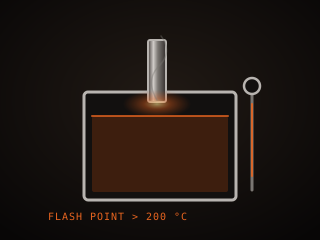
Specifications
| Type | Fast or medium quench oil |
|---|---|
| Use | Hardening blades |
| Flash point | Above 200 °C |
| Tank | Dedicated, with lid |
| Agitation | Move blade to break vapor |
| Maintenance | Filter or replace when dirty |
Technical parameters
| Quench temperature | 40–60 °C warm oil |
|---|---|
| Flash point | Over 200 °C / 390 °F |
| Cooling rate | Fast, below water, above air |
| Steel entry temp | 800–850 °C austenitize |
| Critical range | 800–400 °C rapid cooling |
| Oil volume | 5–20 liters per tank |
| Viscosity | Thin, flows easily |
| Life | Ages with scale and use |
Overview
Quenching oil is the fluid a blade is plunged into to cool it fast enough to harden. When austenitized steel is cooled quickly, its crystal structure transforms into martensite, which is hard but stressed. Oil cools steel slower than water or brine but far faster than air, and that middle rate is what makes it the right choice for most blade steels: fast enough to harden, slow enough to avoid the violent cracking that water can cause. The speed of cooling through the critical range, roughly 800 down to 400 degrees Celsius, is what defines the performance of a quench oil.
When choosing, the main properties are cooling speed, flash point, and stability. A fast oil, sometimes called a fast quench or professional hardening oil, suits shallow-hardening steels, while a slower oil suits alloys that harden more easily. The flash point matters for safety: an oil that flashes below the steel temperature will smoke and can ignite. Viscosity affects how quickly the oil carries heat away and how much it clings to the blade. Oil also ages, picking up scale and breaking down, so it needs occasional filtering or replacement. Never mix oils of unknown type.
In the workflow quenching oil is used at the moment of hardening, right after the blade comes out of the forge or oven at austenitizing temperature. The blade is plunged edge-first or point-first, depending on the steel, and agitated to break the vapor jacket that insulates the steel and slows cooling. A poor quench shows up as soft spots, a mottled surface, or a blade that will not harden at all. Because the oil is hot, fuming, and potentially flammable, it belongs in a dedicated quench tank with a lid, away from ignition sources, and it is the single most safety-critical consumable in heat treatment.
Where it fits
This tool belongs to the Heat Treat stage of the build.
Safety
- Keep a lid and a fire extinguisher at the quench tank, and never quench near open flame; hot oil fumes can ignite.
- Warm the oil and control the steel temperature, since dropping red-hot steel into cold oil can flash and spatter.
- Ventilate the quench area well; burning and vaporizing oil produces smoke and fumes that are harmful to breathe.
Using it well
- Warm the oil to 40–60 °C before quenching; warm oil cools steel more evenly and reduces the risk of cracking.
- Agitate the blade as it enters and keep it moving, so the vapor jacket breaks and the steel cools at a consistent rate.
- Quench edge-first or point-first depending on the steel, and never pause once the steel is out of the heat.
- Keep a tight lid on the tank when not in use to slow oxidation and stop scale and shop dust from contaminating the oil.
Compatible steels
Steels this tool is commonly used with, and which suit its working range.
Related processes
Related tools
Tempering Oven
Temperature-controlled oven for precise tempering and heat treatment.
Blacksmith Tongs
Gripping tool for holding hot steel safely at the anvil and forge.

Coal Forge
Solid-fuel hearth that burns coal or coke for traditional forging.
Blacksmith Hammer
Primary striking tool for moving hot steel on the anvil.
Further reading

How to Start Knife Making: A Beginner’s Guide
Knife making rewards patience more than tools. Here is the honest starting path: one simple steel, a handful of files, and the three skills that actually decide whether your first blade works.
Heat Treatment Explained: Quenching and Tempering
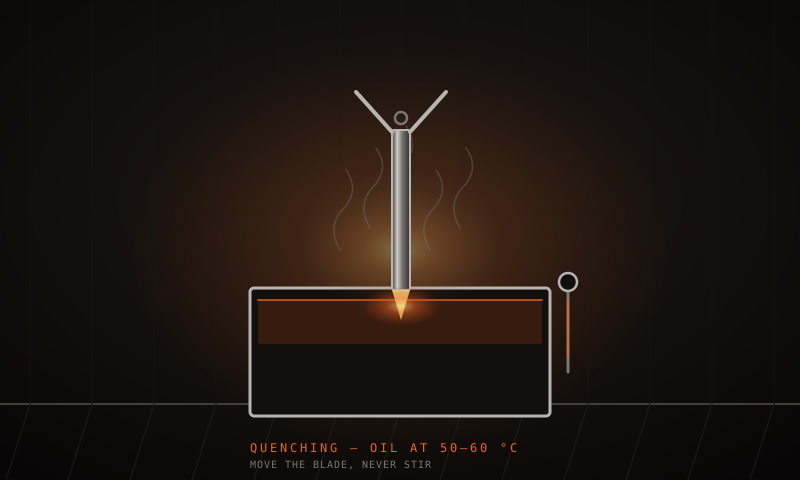
Hardening is a race between two transformations. Get the temperature and the quench right and the steel becomes martensite. Get them wrong and it stays soft. Here is the sequence that works, with real numbers.
Handle Assembly: Materials, Pins, and Finish
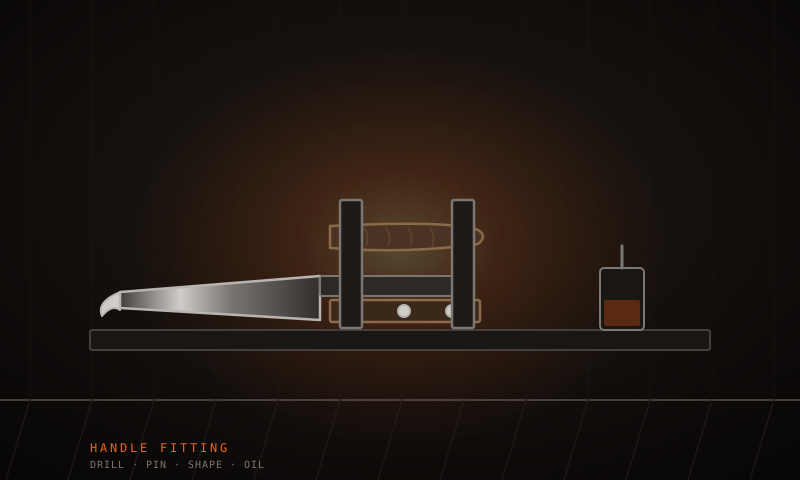
A handle is where the knife meets your hand and the part people notice first. This covers materials, tang prep, epoxy, pins and bolts, and the finishing steps that make it feel like one piece.