Heat Treatment · Heat Treat
Tempering Oven
A tempering oven holds steel at a precise, even temperature for austenitizing and tempering. Accuracy within a few degrees is what makes heat treatment repeatable, especially for alloy and stainless steels that a forge cannot control.
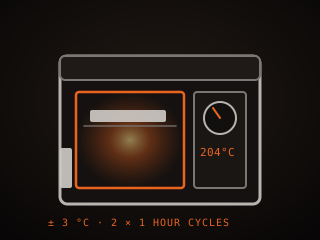
Specifications
| Range | Up to 1,100–1,200 °C |
|---|---|
| Accuracy | ± 3 °C typical |
| Use | Tempering and austenitizing |
| Controller | Digital, with thermocouple |
| Circulation | Fan for even heat |
| Chamber | Sized for blade length |
Technical parameters
| Tempering range | 150–250 °C |
|---|---|
| Austenitizing range | 800–1,080 °C |
| Accuracy | ± 3 °C |
| Uniformity | ± 5 °C across chamber |
| Heat-up time | 10–30 minutes |
| Soak time | 1–2 hours typical |
| Max temperature | 1,100–1,200 °C |
| Power | 1–3 kW |
Overview
A tempering oven is a temperature-controlled chamber used to hold steel at a precise, even temperature for a set time. After quenching, a blade is hard but brittle and full of stress; tempering reheats it to a lower temperature, usually between 150 and 250 degrees Celsius for most blade steels, to trade a little hardness for toughness and relieve internal stress. A dedicated oven holds that temperature within a few degrees and keeps it even throughout the chamber, which is exactly what a forge or a kitchen oven cannot do. That control is why the oven is central to repeatable heat treatment.
When choosing, look at temperature range, accuracy, and uniformity. A blade oven typically reaches 300 to 1,200 degrees Celsius so it can also austenitize stainless and tool steels, while a tempering-only oven may top out lower. Accuracy of plus or minus a few degrees matters because hardness changes quickly with temperature in the tempering range, and uneven heat across a long blade produces soft and hard zones. Good insulation, a fan for air circulation, and a reliable controller with a thermocouple are the features that separate a real heat-treat oven from a generic toaster.
In the workflow the oven handles the two most temperature-sensitive steps in knifemaking: austenitizing before the quench and tempering afterward. For simple carbon steels, a forge and a magnet can get you close, but for alloy and stainless steels the oven is the only way to hit the soak temperature and hold it. The oven also makes results repeatable, which is what lets you tune a heat-treat recipe and trust it. Used carefully, it turns heat treatment from a gamble into a controlled process, and it is the tool that most improves consistency in a small shop.
Where it fits
This tool belongs to the Heat Treat stage of the build.
Safety
- Use oven mitts and a quench-safe surface; the door, racks, and blade are all hot enough to cause instant burns.
- Never leave a heat-treat oven running unattended, since a stuck controller can overheat the steel and the shop.
- Vent fumes from any oil or coating on the blade, and do not put oily or painted steel into a hot oven.
Using it well
- Calibrate the oven against a known thermocouple or a Tempilstik before trusting the controller for critical tempering.
- Let the oven stabilize at temperature before loading the blade, so the steel soaks evenly instead of overshooting.
- Temper for a full hour per inch of thickness, and consider a second temper cycle for high-alloy steels.
- Keep a log of time and temperature for each steel; repeatable results come from records, not from memory.
Compatible steels
Steels this tool is commonly used with, and which suit its working range.
Related processes
Related tools
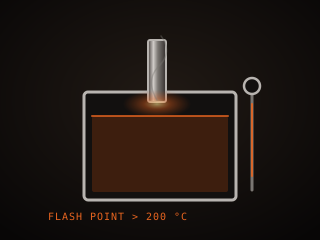
Quenching Oil
Heat-transfer fluid that cools steel fast enough to harden it.
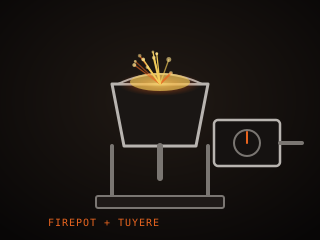
Coal Forge
Solid-fuel hearth that burns coal or coke for traditional forging.
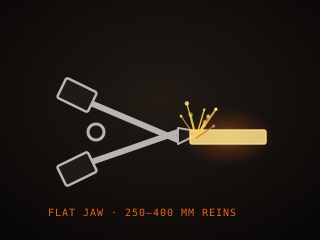
Blacksmith Tongs
Gripping tool for holding hot steel safely at the anvil and forge.
Angle Grinder
Handheld power tool for cutting and rough grinding metal.
Further reading
How to Start Knife Making: A Beginner’s Guide
Knife making rewards patience more than tools. Here is the honest starting path: one simple steel, a handful of files, and the three skills that actually decide whether your first blade works.
Heat Treatment Explained: Quenching and Tempering
Hardening is a race between two transformations. Get the temperature and the quench right and the steel becomes martensite. Get them wrong and it stays soft. Here is the sequence that works, with real numbers.
Handle Assembly: Materials, Pins, and Finish
A handle is where the knife meets your hand and the part people notice first. This covers materials, tang prep, epoxy, pins and bolts, and the finishing steps that make it feel like one piece.