Steel is iron with carbon in it, and almost everything a knife maker cares about follows from how much carbon and what else is in the mix. Below roughly 0.3 percent carbon, steel will not harden no matter how carefully you quench it. Around 0.6 to 1.0 percent, it hardens readily and takes a keen edge. Above about 1.2 percent you start trading toughness for wear resistance and making your own life considerably harder.
The alloying elements are the second half of the story. Chromium, vanadium, manganese, molybdenum and tungsten all change how fast a steel must be quenched, how fine a grain it holds, and how it behaves under the hammer and on the grinder. Two steels with identical carbon can feel completely different to work. This is why the specification matters more than the name on the bar.
What carbon actually does
Carbon is what makes steel hardenable. Dissolved in iron at high temperature, it allows the steel to transform into martensite when you quench it fast enough. Without carbon there is no martensite, and without martensite there is no edge that holds. That single fact explains why mild steel, rebar and most hardware-store flat bar will never make a knife. You can heat them and quench them as carefully as you like, and they will come out of the oil exactly as soft as they went in.
More carbon is not automatically better. At around 0.8 percent you get a steel that hardens easily, takes a fine edge and stays reasonably tough. Push toward 1.0 percent and wear resistance improves while toughness starts to fall. Above roughly 1.2 percent the steel becomes fussy: it wants precise temperatures, it forms large carbides, and a thin edge is far more likely to chip in ordinary use.
The simple carbon steels you will meet
These are the steels a beginner should actually use. They are inexpensive, sold as flat bar, and their behavior is well understood across decades of tool making. The numbers below are the ones worth writing on the wall above your bench. Learn one of them properly before you spend money on anything exotic, because the difference between a well-treated 1084 blade and a badly treated super steel is not close.
1084 and 1095 differ by about a tenth of a percent carbon and behave quite differently. 1095 needs a faster, more decisive quench to harden fully, and it is less forgiving if your oil is slow or your blade is thick. It also tempers lower, at 175–220 °C, to keep its hardness. 5160 is a spring steel: tough, forgiving and easy to forge, but it will not hold an edge as long as a higher-carbon steel at the same hardness.
| Steel | Carbon | Austenitize | Quench and temper |
|---|---|---|---|
| 1075 | ~0.75% | 800–830 °C | Fast oil, 200–230 °C |
| 1084 | ~0.84% | 800–830 °C | Fast oil, 200–230 °C → 58–60 HRC |
| 1095 | ~0.95% | 790–830 °C | Fast oil, 175–220 °C |
| 5160 | ~0.60% | 830–860 °C | Fast oil, 200–230 °C |
Alloying elements and what they change
You do not need to memorize a periodic table, but you should know what the common additions do, because they explain why one steel grinds like butter and another fights you for every pass on the belt. The list below covers the elements you will actually see on a specification sheet, and what each one changes about the way a steel hardens and the way it behaves under your tools.
- Manganese improves hardenability, letting a steel harden in oil rather than water. Most simple carbon steels rely on it.
- Chromium adds wear resistance and corrosion resistance. At 13 percent or more the steel is stainless; below that it mostly just hardens.
- Vanadium refines grain and forms very hard carbides. A little goes a long way and it makes a steel tougher at the same hardness.
- Molybdenum improves hardenability and allows hardening in slower oil or still air, which is why many air-hardening tool steels contain it.
- Tungsten forms extremely hard carbides and holds hardness at high temperature. Useful in tool steels, unpleasant to grind at home.
- Nickel and silicon appear in small amounts. Nickel adds toughness, but too much makes a steel gummy on the grinder and hard to finish.
Tool steels: O1, A2 and D2
Tool steels are formulated for dies, punches and cutting tools, and several of them make excellent knives. They are sold in precision-ground flat bar, which saves a great deal of flattening work, and they are consistent from batch to batch in a way that scrap steel never is. While you are still learning, that consistency is worth paying for, because it removes one whole category of variable from your results.
O1 is an oil-hardening steel with about 0.95 percent carbon and a little tungsten and vanadium. It hardens easily, takes a fine edge, and is a common choice for hand-tool blades and smaller knives. It has almost no corrosion resistance, so it stains readily and needs a little care.
A2 hardens in air, which means less distortion and a slower, more controllable quench. That is genuinely useful for thin or complex blades. D2 carries around 1.5 percent carbon and 12 percent chromium. It is semi-stainless, wears extremely well, and is unpleasant to grind and finish by hand because of its large carbide clusters.
Reading a steel specification sheet
A specification sheet looks intimidating and mostly is not. For knife work you need four things: carbon content, hardenability, the recommended austenitizing range, and the tempering response. Everything else is context you can absorb later. Read those four first and you can judge whether a steel is worth your time before you spend anything on it.
Find the carbon content
This tells you whether the steel can harden and roughly how much wear resistance to expect. Below about 0.3 percent, stop — it is not a knife steel and no heat treatment will change that.
Check the hardenability
Look at manganese, chromium and molybdenum. High totals mean an oil or air quench will work. Low totals mean you need a fast oil, or water with the warping and cracking risk that brings.
Read the austenitizing range
This is your target temperature, usually given as a spread of 20–40 °C. Aim for the lower half for finer grain and better toughness, the upper half only when you need maximum hardness.
Look at the tempering curve
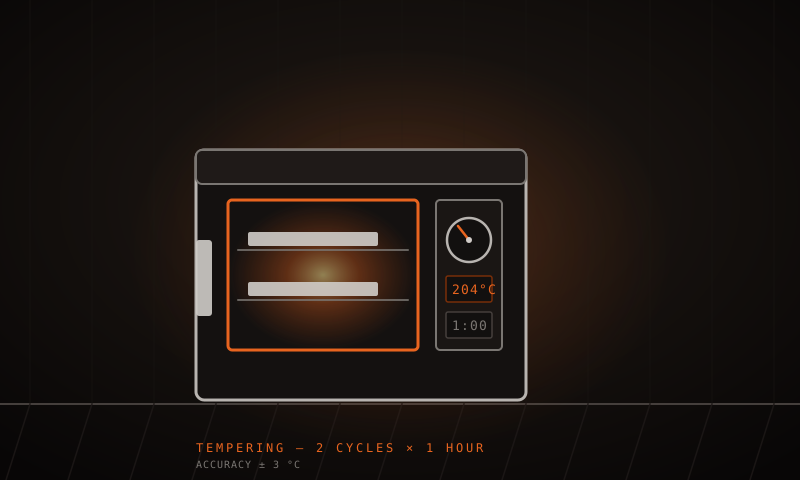
Most sheets plot hardness against tempering temperature. Pick the temperature that gives the hardness you want, and remember you will temper twice for one hour per cycle, not once.
Note the as-received condition
Annealed flat bar is soft, drills easily and files well. Some bar arrives normalized or even partially hardened. Check before you cut, because drilling hardened steel is a short lesson in frustration.
The scrap steel problem
Old files, leaf springs, saw blades and ball bearings have made thousands of good knives. They are also the reason many beginners give up. You cannot know the carbon content, the alloy or the prior heat treatment of a scrap part, so when a blade comes out soft or cracks in the quench you have no way to tell which variable failed.
If you want to use scrap, treat it as an experiment rather than a shortcut. Cut a small test coupon from the same piece, harden and temper it alongside the blade, then break it in a vise. Look at the grain: fine and silky grey is good, coarse and bright is not. That test costs ten minutes and tells you more than any identification chart.
Key takeaways
- Steel needs roughly 0.6 percent carbon or more to harden into a usable knife edge; below 0.3 percent it never will.
- 1084 austenitizes at 800–830 °C and tempers at 200–230 °C for about 58–60 HRC. It is the most forgiving beginner steel.
- 1095 wants 790–830 °C with a fast, decisive quench and tempers lower at 175–220 °C to hold its hardness.
- 5160 is a tough spring steel that forges and hardens easily, but it trades edge holding for resistance to chipping.
- Read carbon, hardenability and tempering data first. Alloying elements change grain size, wear resistance and quench speed.
Frequently asked
Yes, considerably. Most stainless knife steels need precise and often high austenitizing temperatures, a fast controlled quench, and sometimes cryogenic treatment or a long temper to reach their best. A simple carbon steel like 1084 teaches you the process with far fewer variables. Move to stainless once your carbon steel blades come out consistently hard.
You can harden some simple steels that way, but the magnet only tells you the steel has passed roughly 770 °C, which is below the 800 °C-plus most knife steels need. Water quenches fast enough for many simple steels but causes more warping and cracking than oil. Treat the magnet as a rough lower bound, never as a target.
Almost always the quench. 1095 must cool faster than 1084 to miss the pearlite transformation, so slow oil, a thick blade or a timid quench leaves it under-hardened. Warm the oil, use a proper fast-quenching oil, move the blade briskly, and confirm you were at 790–830 °C before the blade entered the oil.
Related articles
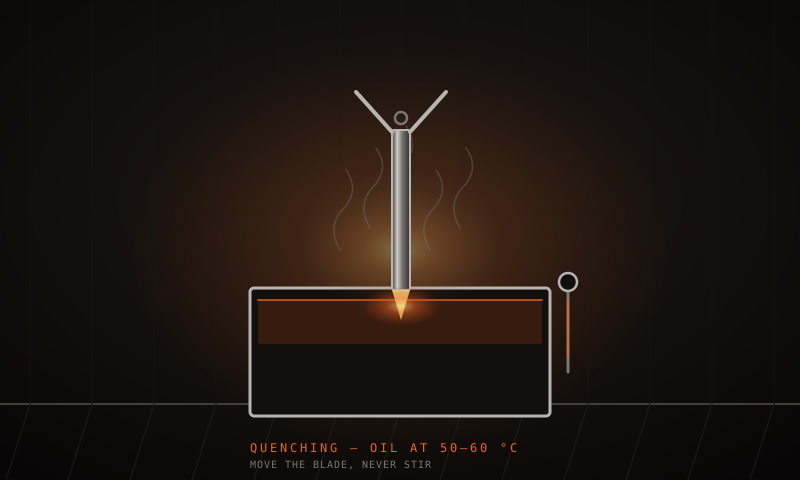
Heat Treatment Explained: Quenching and Tempering
Hardening is a race between two transformations. Get the temperature and the quench right and the steel becomes martensite. Get them wrong and it stays soft. Here is the sequence that works, with real numbers.
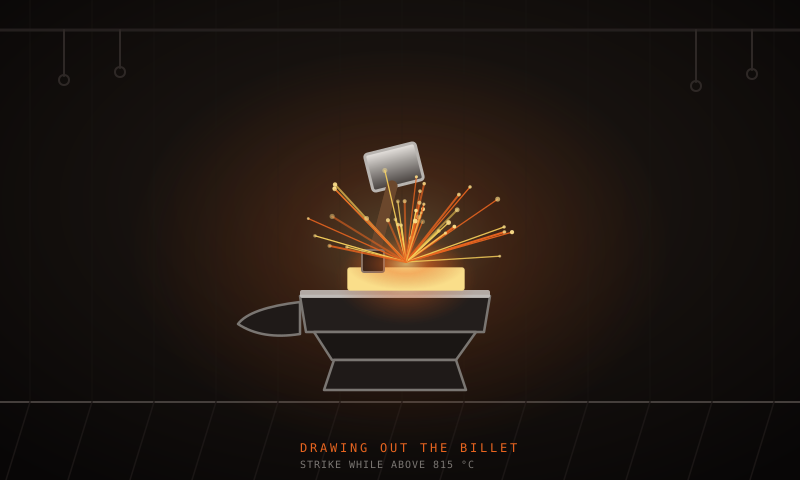
Forging Basics: Heating, Hammering, and Shaping
Forging is not about hitting hard. It is about heat, hammer control and knowing when to stop. This covers the working temperatures, the hammer work, and the faults that show up in every beginner blade.

How to Start Knife Making: A Beginner’s Guide
Knife making rewards patience more than tools. Here is the honest starting path: one simple steel, a handful of files, and the three skills that actually decide whether your first blade works.